Claude Opus 5: #1 on Every Leaderboard, Half the Price of Fable 5
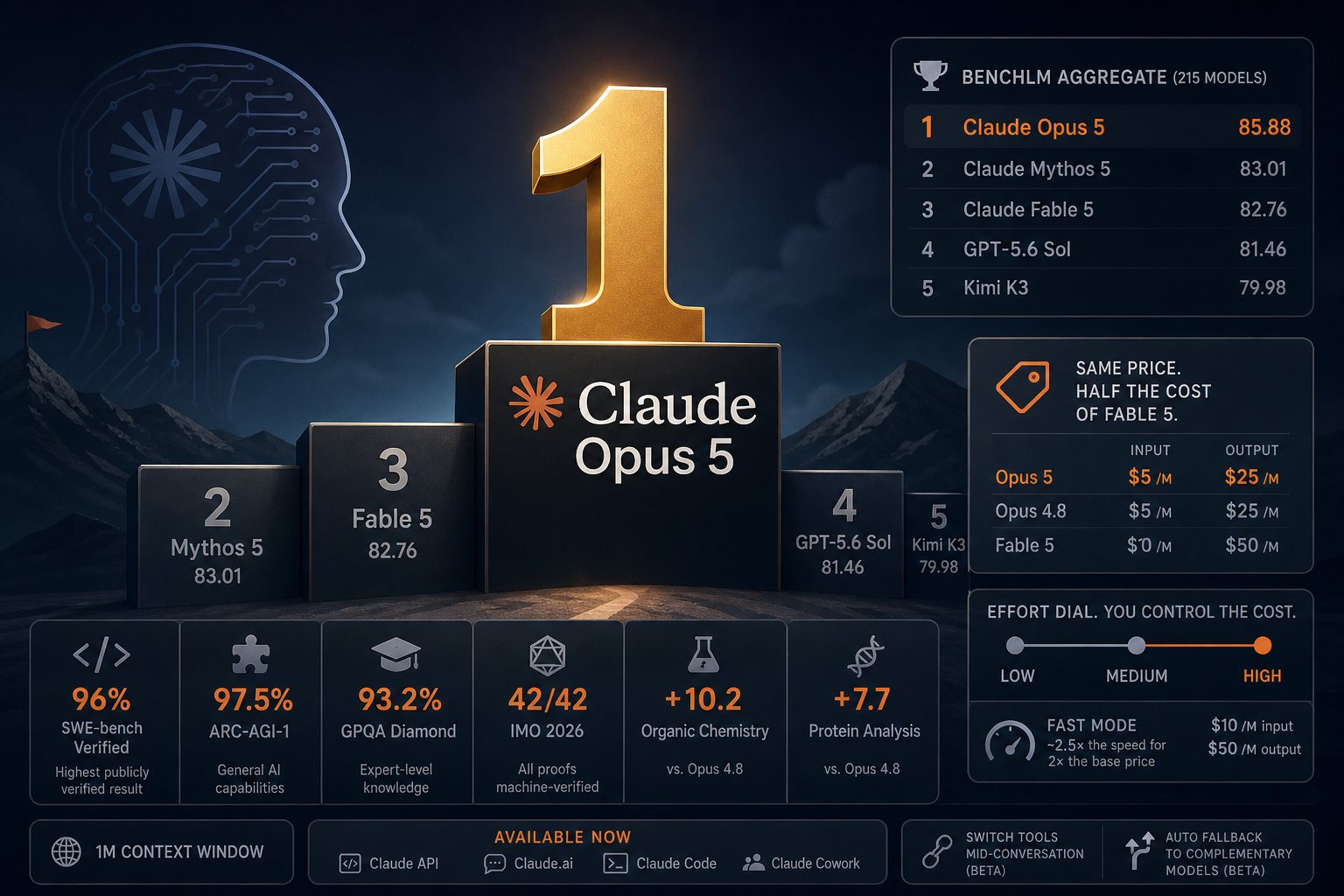
Anthropic released Claude Opus 5 on July 24, 2026, and within hours it was sitting at the top of every major independent benchmark — including ranks above the company's own pricier Fable 5. The pricing headline is blunt: $5 per million input tokens and $25 per million output tokens, the same as its predecessor Opus 4.8 and exactly half of what Fable 5 costs. The model doesn't ask you to pay more to get more.
What the Benchmarks Actually Show
Third-party leaderboards are a more useful sanity check than vendor-run numbers, and Opus 5 cleared them convincingly. On BenchLM's aggregated ranking across 215 models, it scored 85.88 and took the top spot — above Anthropic's own Claude Mythos 5 (83.01), Claude Fable 5 (82.76), OpenAI's GPT-5.6 Sol (81.46), and Moonshot's Kimi K3 (79.98). Artificial Analysis's Intelligence Index puts Opus 5 at 61, one point above Fable 5's 60. The Agentic Index ranking follows the same pattern: Opus 5 at #1.
The task-specific numbers are harder to dismiss. On SWE-bench Verified — real software engineering problems drawn from open-source repos — Opus 5 scored 96%, the highest publicly verified result to date. It scored 97.5% on ARC-AGI-1, 93.2% on GPQA Diamond (expert-level knowledge), and earned a perfect 42/42 on IMO 2026, with every generated proof machine-verified. For scientific work, it added 10.2 points over Opus 4.8 on organic chemistry tasks and 7.7 points on protein analysis benchmarks. These are the kinds of numbers that belonged to five-figure-per-month systems not long ago.
The Effort Toggle: Cost Control Per Request
The most practically useful new feature isn't a benchmark — it's the per-request effort dial. Opus 5 ships with low, medium, and high effort settings that let you control how much compute (and chain-of-thought reasoning depth) goes into each call. Routine classification or summarization tasks don't need max-effort reasoning, and now you don't pay for it when you don't need it. At lower effort, Opus 5 reportedly preserves much of its performance while reducing token usage.
Alongside that, there's Fast Mode: approximately 2.5× the default speed for 2× the base price, landing at $10 per million input tokens and $50 per million output tokens. That's Fable 5 territory on cost but with a #1-ranked model underneath. If you're building latency-sensitive pipelines or batch-processing large volumes of content, Fast Mode gives you an explicit tradeoff to work with rather than a one-size-fits-all rate.
Availability and What Ships Now
Opus 5 is live across the Claude API, Claude.ai, Claude Code, and Claude Cowork as of launch. It's the new default on Claude Max and the strongest model available on Claude Pro. The context window holds at 1 million tokens, consistent with Opus 4.8 and Fable 5, so existing integrations don't need retrofitting. Two beta features are rolling out alongside: the ability to switch tools mid-conversation, and automatic fallback to complementary models when a task shifts outside the primary model's strengths — useful for agentic pipelines that cross domain boundaries.
Where It Sits Against the Field
GPT-5.6 Sol is Opus 5's closest competitor at the same accessibility tier. The BenchLM aggregate puts Opus 5 ahead (85.88 vs. 81.46), and Anthropic's third-party agentic benchmarks hold up the same order. On software engineering specifically, 96% on SWE-bench Verified is the current high-water mark; OpenAI hasn't published a verified SWE-bench number at the same evaluation tier for Sol.
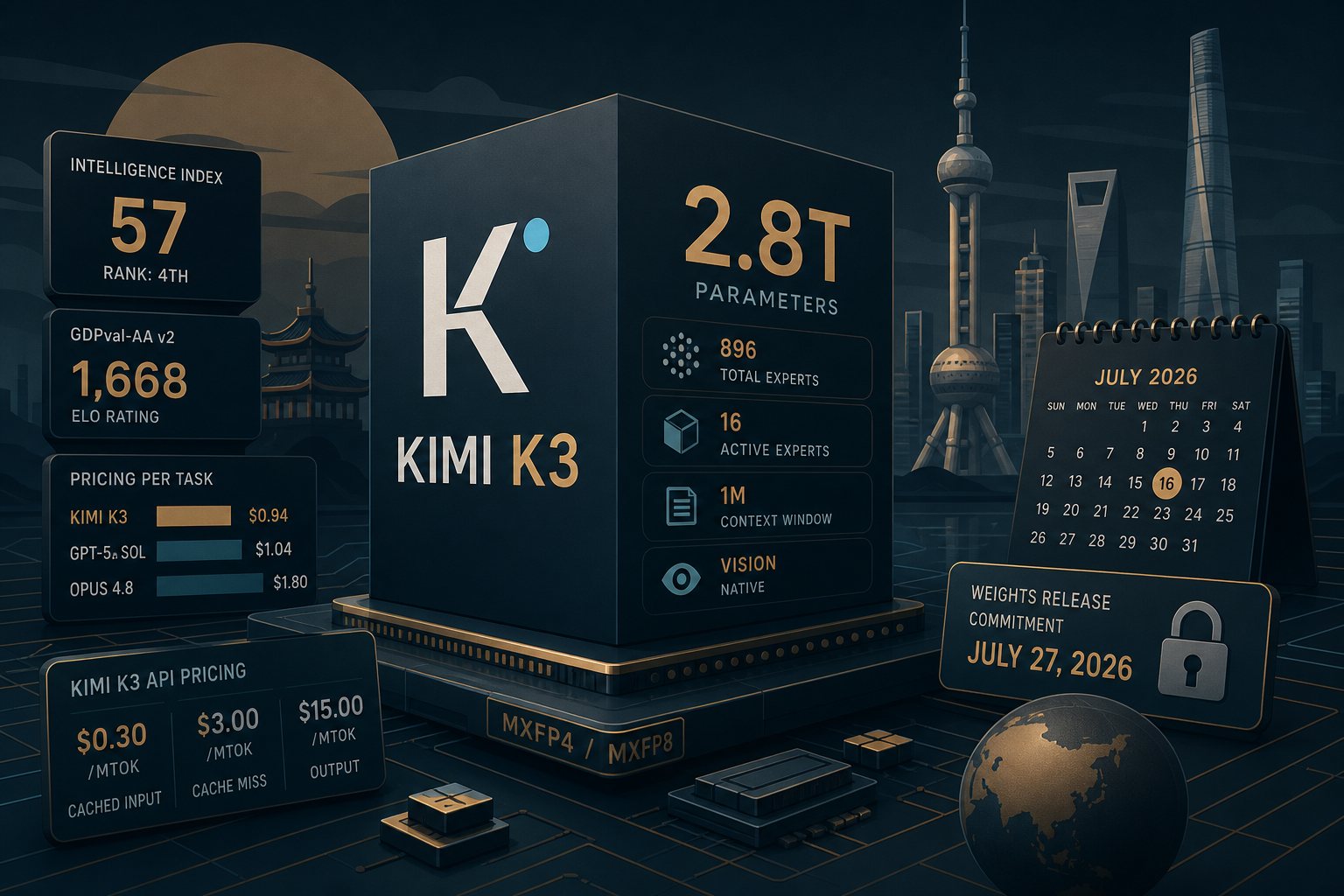
Kimi K3, which Moonshot released July 16 as the largest open-weight model at 2.8 trillion parameters, benchmarks competitively on knowledge tasks but trails on agentic and multi-step reasoning evaluations. If your team's priorities include on-premises deployment or hard API independence, K3 remains worth evaluating. If you want the best available performance through an API at a predictable and auditable cost, Opus 5 is now the default recommendation.
What This Changes for Your Operations
The practical effect is that the price barrier separating "good enough AI" from "best available AI" has collapsed for one more tier. Teams that capped themselves at Sonnet-class models for cost reasons now have a path to the top of the leaderboard at $5/M input without changing their budget math. The effort dial makes that even more manageable: low-effort calls for high-volume work, max-effort calls for complex reasoning — and you control the split per request in your code.
For small to mid-size engineering teams, the 96% SWE-bench score is the most concrete number. Automated code review, test generation, and PR triage pipelines running on a model that solves 96% of real software engineering problems is a different proposition than one solving 70%. For content, research, or customer-data workflows, 93.2% on expert-level knowledge questions means fewer hallucination guardrails to build around.
One deliberate limitation worth knowing: Anthropic held Opus 5 below Mythos 5 on cybersecurity exploitation tasks. That's not a capability gap — it's an intentional safety constraint. For security-adjacent applications like automated log analysis, threat intelligence summarization, or code audits, Opus 5 is fully capable. It just isn't trained to help an attacker get further once they're already in. That distinction matters when evaluating it for security tooling.
At Falcon Internet, we watch these releases for what they shift in the practical toolkit — and a #1-ranked model at mid-tier pricing shifts quite a bit.