127 Patches and No Rollback: July 2026 Patch Tuesday's Kerberos Breaking Change
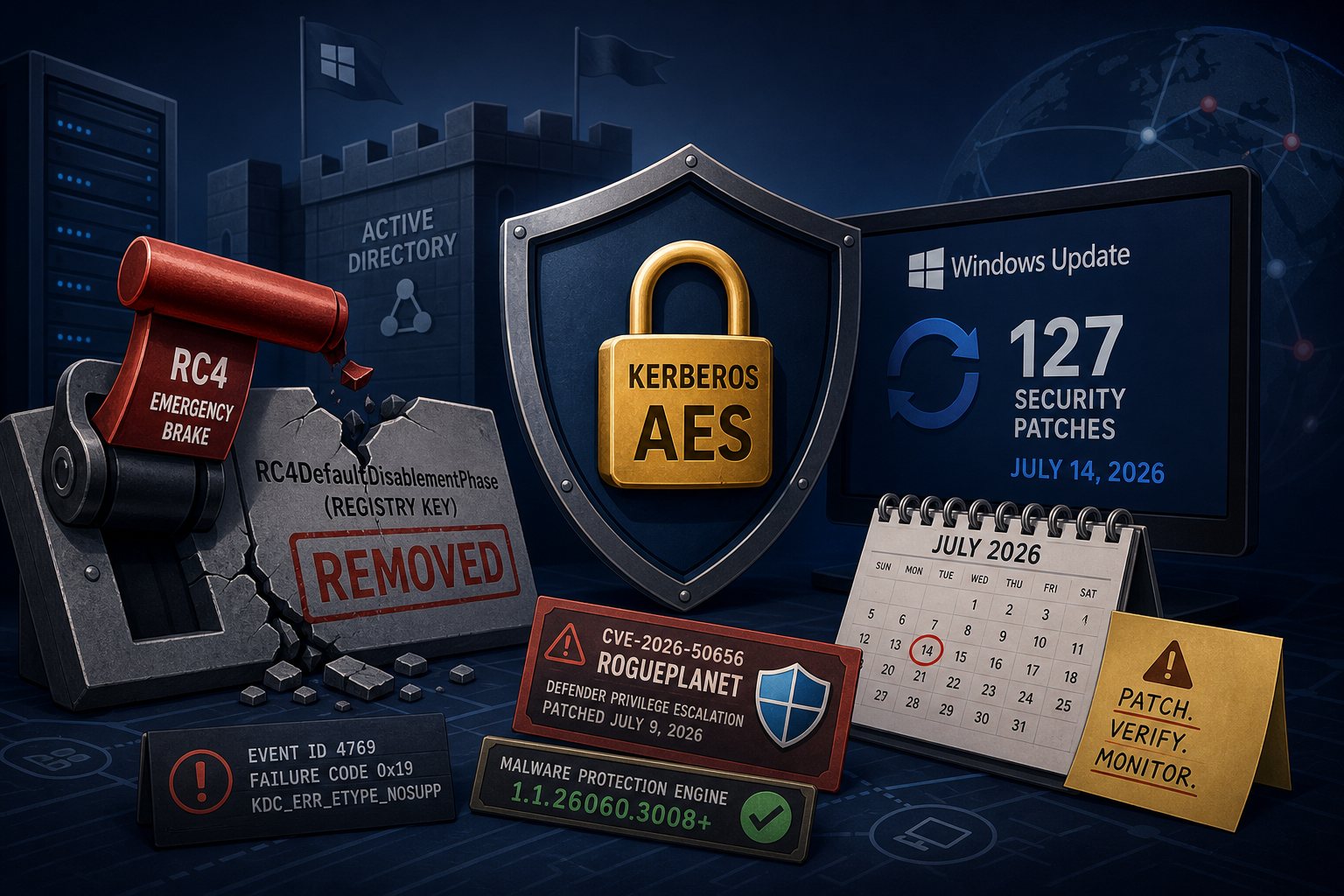
Microsoft released 127 security patches today — Patch Tuesday, July 14, 2026. That number sounds manageable until you look at context: June shipped a record 206, Chrome just pushed 433 fixes in a single version, and Microsoft is on track to surpass 1,000 CVEs patched in a calendar year for the first time ever. But the count itself isn't the most urgent story today. The most urgent story is one patch that doesn't add anything — it permanently removes a safety net your Active Directory may still be standing on.
The Kerberos RC4 Point of No Return
Today's cumulative update removes the RC4DefaultDisablementPhase registry key from all supported Windows Server domain controllers. That key has been the emergency brake for organizations migrating away from RC4 encryption in Kerberos since January 2026. As of this update, it is gone.
The underlying issue is CVE-2026-20833, an information disclosure vulnerability that enables Kerberoasting — a well-understood attack where an adversary requests service tickets encrypted with RC4 and then cracks them offline. RC4's key weakness isn't the algorithm's age; it's that service account passwords encrypted with it can be brute-forced on commodity hardware far faster than with AES. Microsoft rolled this hardening out in deliberate phases: audit mode in January 2026 (event IDs 201, 202, 205–207 on domain controllers), enforcement mode in April 2026 (accounts without AES key material began failing authentication), and today — the registry rollback is gone.
If your organization hit authentication failures in April and used the registry key to buy time, that time is up. Service accounts, SQL Server linked server credentials, application pools using Windows authentication, cross-forest trusts configured for RC4, and legacy systems — older MIT Kerberos builds below 1.15, pre-Mavericks macOS clients, some network appliances — can all break. Authentication failures will surface as event ID 4769 with failure code 0x19 (KDC_ERR_ETYPE_NOSUPP).
The fix is account-level: ensure every service account has AES encryption type attributes set. The PowerShell approach is to enumerate accounts with msDS-SupportedEncryptionTypes set to RC4-only (value 4 with no AES flags), then force a password reset — which triggers AES key generation automatically — or manually add encryption type flags 0x8, 0x10, and 0x20. Cross-forest trusts need to be reconfigured at the trust object level. The time to discover you missed something is in your event logs right now, not in a 2 a.m. outage call after you apply tonight's patches.
RoguePlanet: Verify the Emergency Patch Is There
The second item worth immediate attention is CVE-2026-50656, the Windows Defender privilege escalation flaw publicly named RoguePlanet. Microsoft issued an out-of-band emergency patch on July 9 — five days ago — because a working proof-of-concept that drops a SYSTEM shell had been public since June 10. The race condition lives in the Microsoft Malware Protection Engine, the scanning core shared by Defender, Defender for Endpoint, and several other Microsoft security products.
This one carries a CVSS score of 7.8 and requires local access to exploit — an attacker already on your machine, or a compromised standard user account, can escalate to full SYSTEM control. The fix is an engine update, not a Windows OS patch: you're looking for Microsoft Malware Protection Engine version 1.1.26060.3008 or later. On most managed endpoints this arrived via automatic engine updates; on isolated or tightly controlled environments it may not have. Check before assuming.
127 Patches Is Now a Slow Month
July's 127 CVEs will probably get filed as "back to normal" compared to June's 206, but the baseline itself has shifted dramatically. Pre-2026, Microsoft's monthly average ran 60 to 90. The driver is AI-assisted vulnerability discovery — automated fuzzing, static analysis, and variant hunting are finding bugs faster than security teams can triage them, let alone patch them. Adobe acknowledged the same pressure by moving to a twice-monthly release cadence. The practical consequence for IT and security teams is that "assess every CVE" as a workflow is effectively dead. You can't meaningfully review 1,000 vulnerabilities per year at the depth that process implies.
What has to replace it is a layered triage: patch immediately when there's a working public exploit or CISA KEV listing, run monthly cumulative updates on a predictable schedule for everything else, and invest more heavily in network segmentation and least-privilege so that unpatched systems aren't reachable from anything critical. The RoguePlanet timeline — public PoC on June 10, patch on July 9 — is a reminder that 29 days is a long time to leave a SYSTEM-level exploit unaddressed.
Also on the July 14 calendar: Oracle's Critical Patch Update drops next Tuesday, July 21. If Oracle products run in your environment, block that time now.
What to Do Today
- Before patching domain controllers: Run
Get-ADUser -Filter * -Properties msDS-SupportedEncryptionTypesand the equivalent for service accounts and computer objects. Identify any still flagged RC4-only. Force password resets or update encryption type attributes now. - Verify RoguePlanet patch: Confirm Microsoft Malware Protection Engine is at version 1.1.26060.3008 or later on all Windows endpoints, especially machines that don't pull automatic engine updates.
- Apply July 14 cumulative updates on your normal patching cadence — but prioritize domain controllers for the RC4 change, and ensure any test environment goes first so you catch authentication breakage before production does.
- Watch event ID 4769: Post-update, monitor domain controller security logs for failure code
0x19. Any hit there is a service account or trust that still needs AES migration.
At Falcon Internet, this kind of compounding deadline — a phased enforcement with a hard cutoff — is exactly what our 24x7x365 NOC monitoring exists to catch before it becomes a 2 a.m. incident. The event log evidence is there months before anything breaks; the challenge is having someone watching it.