Kimi K3: The 2.8-Trillion-Parameter Open Model That Just Shook the AI Market
On July 16, Moonshot AI dropped Kimi K3 — a 2.8-trillion-parameter open-weight model that the company says is the largest ever released to the public. The timing was deliberate: it lands one day before the 2026 World Artificial Intelligence Conference opens in Shanghai, and the message is hard to miss. Chinese AI is not playing catch-up anymore.
What Kimi K3 Actually Is
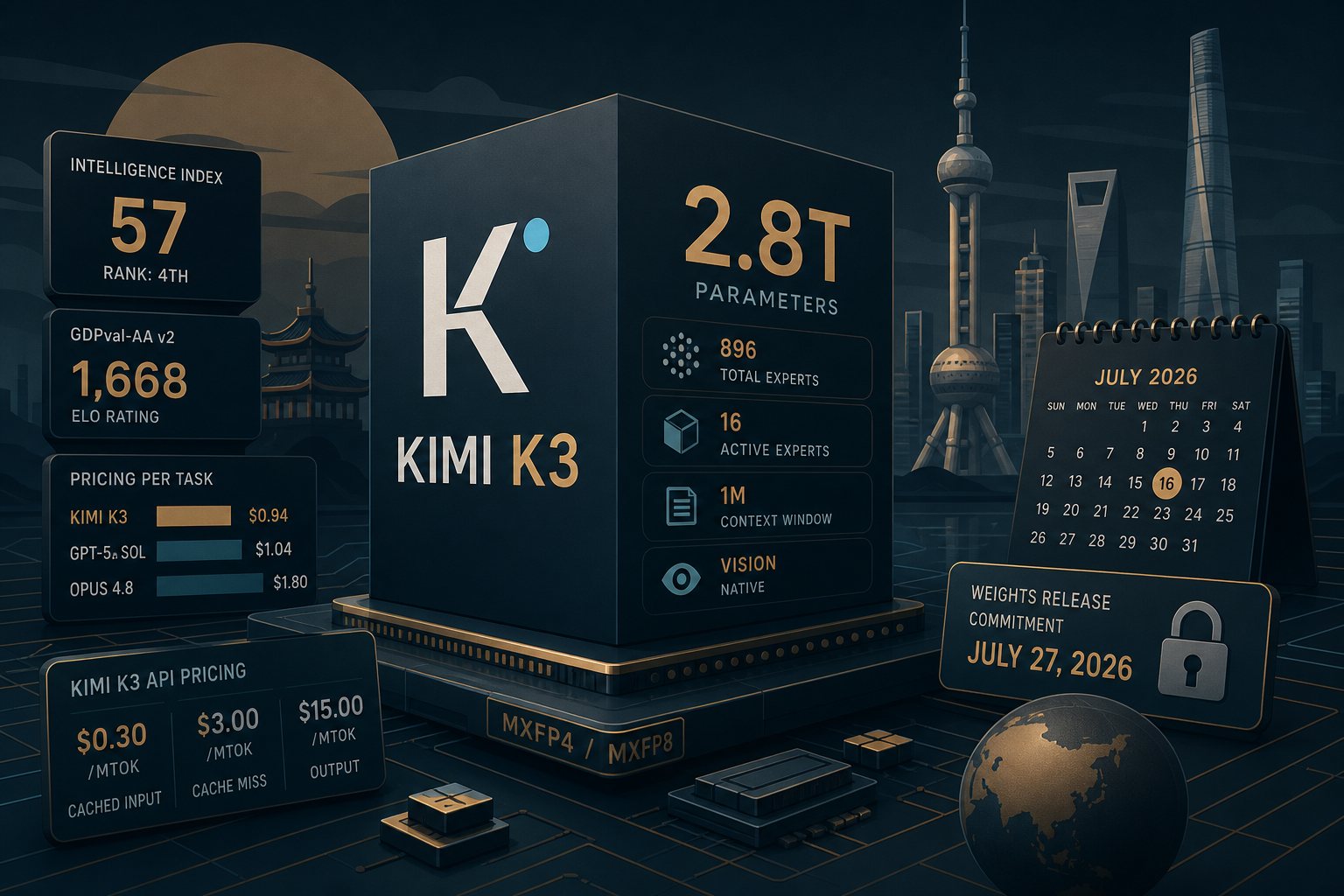
K3 is a Mixture-of-Experts (MoE) model with 896 total experts, 16 of which activate on any given inference pass — a design that keeps compute costs manageable despite the staggering total parameter count. It ships with a 1-million-token context window (roughly 750,000 words), native vision capabilities, and what Moonshot calls an always-on thinking mode.
The architectural novelty comes from two Moonshot-developed techniques: Kimi Delta Attention (KDA), a hybrid linear attention mechanism, and Attention Residuals, described as a drop-in replacement for standard residual connections that delivers consistent scaling gains at both depth and sequence length. The model was also trained with quantization-aware techniques using MXFP4 weights and MXFP8 activations, targeting efficient deployment on modern accelerators.
Where It Sits on the Leaderboard
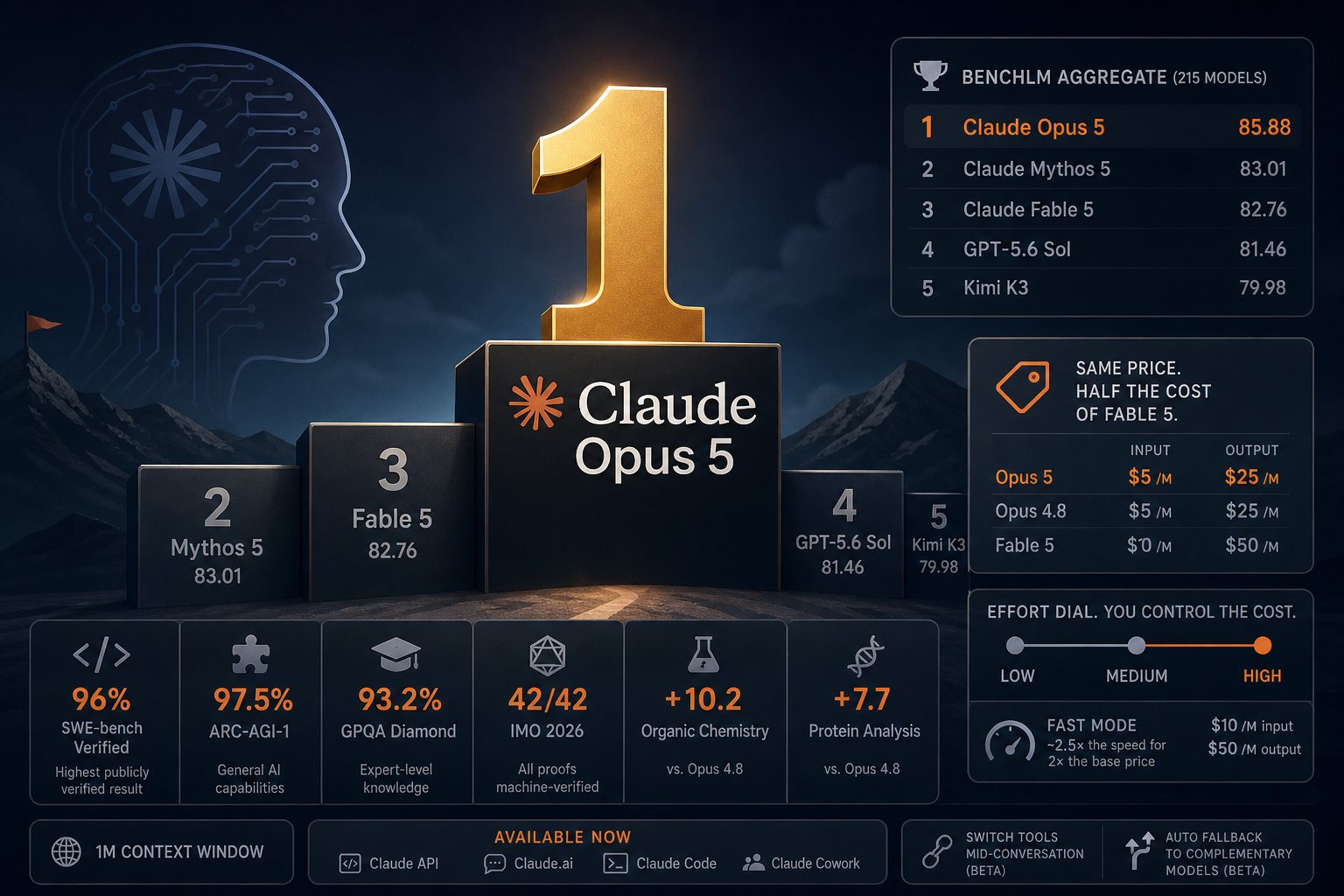
Artificial Analysis, an independent benchmarking organization, scores K3 at 57 on its Intelligence Index — placing it fourth overall, behind Claude Fable 5 (60), GPT-5.6 Sol (59), and just ahead of Opus 4.8 (56). On GDPval-AA v2, a benchmark measuring real-world task performance across 44 occupations and 9 industries, K3 earns an Elo rating of 1,668, behind Fable 5 (1,760) but ahead of most other competitors.
On coding-specific evaluations — DeepSWE, SWE Marathon, FrontierSWE — K3 is competitive with the best proprietary systems. Arena.ai's front-end development leaderboard ranked K3 above both Fable 5 and GPT-5.6 Sol, though that leaderboard skews toward visual output quality rather than correctness.
One number stands out more than the wins: K3's hallucination rate increased from 39% to 51% compared to its predecessor K2.6, even as raw task accuracy improved from 33% to 46%. The model is simultaneously more capable and more confidently wrong. That is a pattern worth factoring in before deploying it anywhere that does not have a human review layer.
The Pricing Math
K3's API is live now, priced at $0.30/MTok for cached input, $3.00/MTok for cache misses, and $15.00/MTok for output. Moonshot reports cache hit rates above 90% on coding workloads, which matters for the real-world per-task cost. Averaged across task types, independent analysis puts that figure around $0.94 per task — cheaper than GPT-5.6 Sol ($1.04) and substantially below Opus 4.8 ($1.80).
The interesting comparison, though, is Moonshot's own prior model. K2.6 ran at $0.16/$0.95/$4.00 input/cache-miss/output — a fraction of K3's price. K3 requires 21% fewer output tokens to complete the same tasks, but the per-task cost still comes out higher. The Decoder noted this marks the end of Moonshot's ultra-cheap pricing strategy. Chinese frontier AI is no longer synonymous with bargain pricing. (DeepSeek V4 Pro, for contrast, still averages around $0.04 per task.)
The Open-Weight Catch
Here is the part that changes the calculus for self-hosters: K3 is available via API today, but the full model weights are not yet public. Moonshot has committed to releasing them by July 27, 2026. Until that date, K3 is open-weight announced, not open-weight available.
Once weights drop, the practical infrastructure requirements are serious. Running 2.8 trillion parameters even at 4-bit quantization demands a substantial GPU cluster — this is not a single-server deployment for most organizations. Expect community-optimized quantized variants to appear quickly after the weights release, which will make it accessible to more teams. But that is a few weeks away and depends on the license terms Moonshot ships alongside the weights.
What to Watch Before You Commit
For most small and mid-size businesses, the immediate impact of K3 is indirect: more competition at the frontier pushes pricing pressure across the entire market. Anthropic and OpenAI have been gradually cutting prices for months; a credible open-weight alternative at the top of the performance range makes that pressure harder to ignore. If your organization uses AI tools for coding assistance, content workflows, or customer-facing chatbots built on API calls, watch the post-July 27 landscape — especially once derivative fine-tunes appear.
A few specific things to weigh before adopting K3 in any production capacity:
- Hallucination rate: The jump from 39% to 51% is significant. Any use case that relies on factual accuracy — customer-facing FAQs, legal or compliance summaries, data extraction — needs human review or a retrieval-grounded setup.
- Vendor scrutiny: Anthropic has previously alleged that Moonshot used Claude outputs to train K-series models in violation of its terms of service. That allegation remains unresolved. Organizations with strict vendor vetting processes should document how they are assessing it.
- Data residency and export controls: As with any Chinese AI product, organizations subject to ITAR, CMMC, or sector-specific data handling requirements should run their legal team's eye over API data flows before going to production.
- Weights license: The license has not shipped yet. Whether K3 will allow commercial self-hosting, fine-tuning, or redistribution is unknown as of this writing. This is the critical variable for teams planning to run it locally.
The Bigger Picture
K3 is at least the third major open-weight moment in 18 months where a Chinese model landed at or near the Western frontier. Each release has compressed the innovation timeline and expanded what is available outside the closed API ecosystem. The pattern matters more than any individual model: frontier-class AI is becoming more accessible, more distributed, and cheaper — and it is coming from more directions than it was a year ago.
The practical takeaway for teams shopping AI tools right now: wait two weeks, see what the weights license says, and let the community benchmarking catch up. July 27 is the real news day here.