SonicWall SMA1000 Zero-Days: CVSS 10.0 + RCE in Active Exploitation — Patch Before July 17
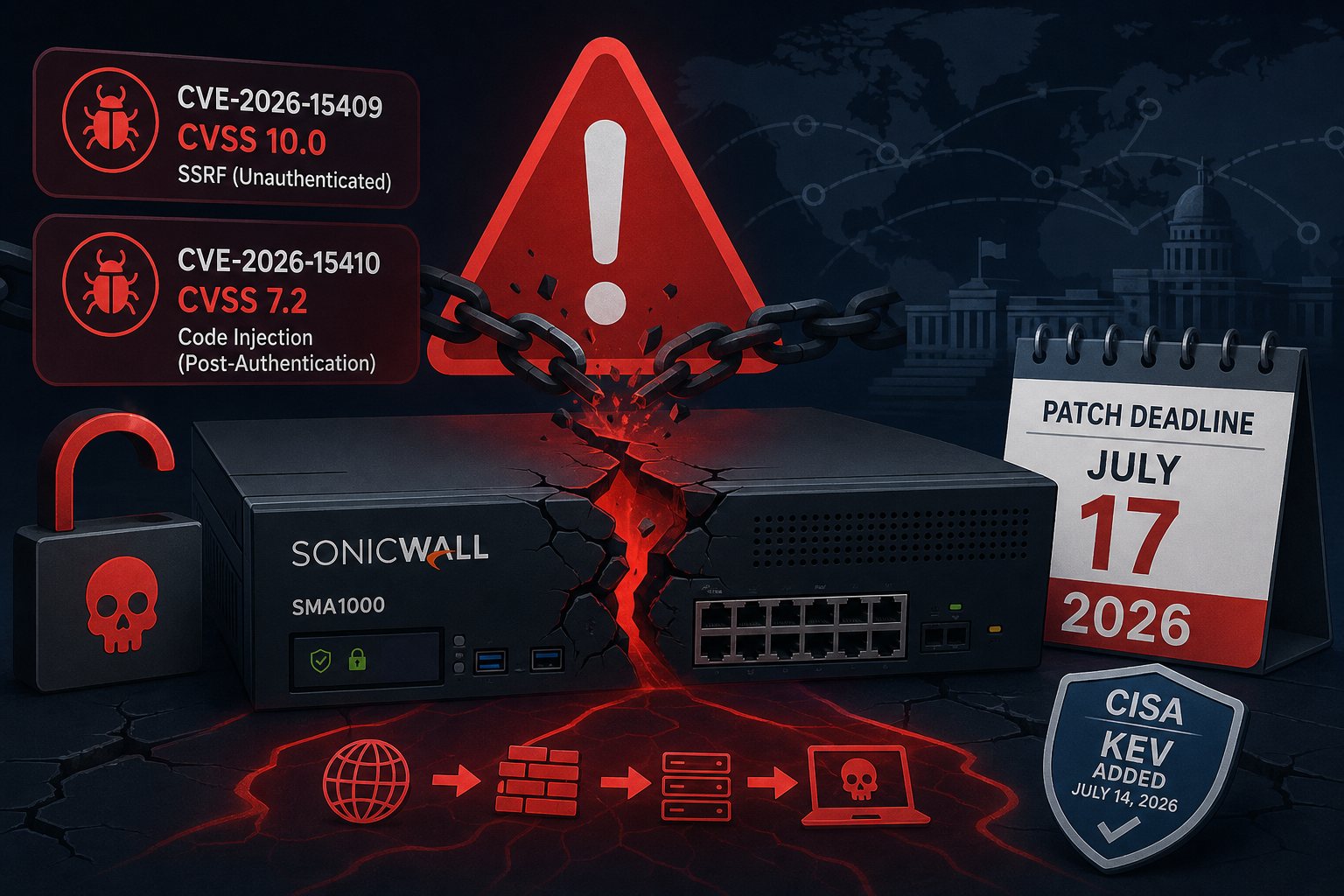
On July 14, 2026, SonicWall issued an emergency security advisory confirming that threat actors are actively exploiting two zero-day vulnerabilities in its SMA1000 series of remote-access appliances. The more severe flaw carries a CVSS score of 10.0 — the maximum. CISA added both vulnerabilities to its Known Exploited Vulnerabilities catalog the same day and gave US federal civilian agencies until July 17, 2026 to patch or pull the plug. That deadline applies to federal agencies under Binding Operational Directive 26-04, but the logic behind it applies to everyone: when a CVSS 10.0 bug is being weaponized in the wild, the window between advisory and mass exploitation is measured in hours.
Two Bugs, One Lethal Chain
CVE-2026-15409 (CVSS 10.0) is a server-side request forgery (SSRF) flaw in the SMA1000 Appliance Work Place interface. An unauthenticated remote attacker can force the appliance to make outbound HTTP requests to any destination they choose — including internal management interfaces that are otherwise firewalled from the public internet. No credentials required.
CVE-2026-15410 (CVSS 7.2) is a post-authentication code injection vulnerability in the Appliance Management Console. An attacker with administrative access can inject arbitrary operating system commands and execute them with admin privileges.
Individually, each flaw is serious. Chained together, they become an unauthenticated remote code execution path: 15409 gets an attacker into internal-only interfaces; 15410 turns administrative console access into shell command execution. Help Net Security notes the vulnerabilities are being exploited in combination in observed attacks. Volexity researchers Sean Koessel and Steven Adair assisted SonicWall PSIRT in identifying additional indicators of compromise after the initial discovery by Adam Babis — which is a signal that exploitation had already generated enough forensic debris to analyze.
What's Affected
The vulnerable product line is the SonicWall SMA1000 series, specifically models SMA6210, SMA7210, and SMA8200v. These are enterprise-grade SSL VPN and remote access gateways deployed in corporate networks to provide secure remote access for employees and administrators.
Vulnerable firmware versions span:
- 12.4.3-03245, 12.4.3-03387, 12.4.3-03434
- 12.5.0-02283, 12.5.0-02624, 12.5.0-02800
The fixes are in platform-hotfix releases 12.4.3-03453 and 12.5.0-02835. If you're on any version between those bounds, you're vulnerable right now.
SonicWall's Recurring Vulnerability Problem
This is not a one-off. SecurityWeek points out that SonicWall products now account for 17 entries in CISA's Known Exploited Vulnerabilities catalog. That's not a coincidence — it reflects that attackers have learned SonicWall remote-access products are high-value targets. Compromise a VPN appliance and you have a trusted, persistent foothold inside the network it protects. No phishing, no endpoint detection to evade — just a direct tunnel into the corporate LAN.
Prior SonicWall campaigns have been attributed to ransomware groups and nation-state actors alike. This advisory does not attribute the current exploitation, but the target profile and exploitation pattern are consistent with financially motivated threat actors using perimeter devices as initial access. Whether the attacker monetizes access through ransomware, credential theft, or sale to a broker, the entry point is the same unpatched appliance.
What to Do Right Now
If your organization uses SonicWall SMA1000 hardware, the action list is short and urgent:
- Identify exposure: Confirm whether you have SMA6210, SMA7210, or SMA8200v appliances and check their current firmware version in the Management Console.
- Patch immediately: Apply hotfix
12.4.3-03453(for the 12.4.x branch) or12.5.0-02835(for the 12.5.x branch). SonicWall's advisory provides direct download links. - Audit logs before and after: Look specifically for anomalous API requests, unexpected proxy traffic, and unusual access patterns through the Work Place interface. Volexity's involvement suggests there are detectable IoCs.
- If compromise is suspected: SonicWall's guidance is explicit — re-image the appliance from a clean image and rotate all credentials and tokens that were stored on or accessible through the device. Patching a compromised host does not remove an attacker who is already inside.
- Limit exposure surface: If the Management Console is internet-accessible, restrict it to known management IP ranges immediately, regardless of patch status.
The Broader Lesson for Perimeter Devices
Remote-access appliances — VPN concentrators, SSL gateways, and similar perimeter devices — have become one of the most consistently exploited categories in enterprise security. They sit at the edge of the network with broad internal trust, run as dedicated embedded systems that are harder to monitor with standard EDR tools, and are frequently left on vendor-default configurations or forgotten between firmware cycles.
A CVSS 10.0 with active exploitation is as loud as an alarm gets. At Falcon Internet, our 24x7x365 NOC monitoring flags anomalies in traffic patterns, but visibility only matters if there's something left to observe — a patched system doesn't generate incident response tickets. Perimeter devices deserve the same patching discipline as any public-facing server. In 2026, the attackers learned that lesson before many defenders did.